Course 126: Safety
and Sanitation
Creating and maintaining a safe and sanitary food service operation
is more important than ever as concerns about food-borne illnesses
and food spoilage have become a focus in the news and in our everyday
life. This critical class focuses on the many procedures and techniques
to run a safe and sanitary kitchen. You learn to identify foods susceptible
to hazardous microorganisms and gain insight into purchasing, storage,
preparation and serving procedures that promote food safety. Learn
how to use knives and other cutting tools safely, how to lift and
carry properly, how to administer basic first aid, including how to
perform the Heimlich maneuver.
1 Credit, 16 hours
Level: Introductory
Prerequisite: None
Next: HACCP (Hazard Analysis Critical Control Point) |
 |
Course 127: HACCP (Hazard Analysis Critical
Control Point)
Students are guided through HACCP principles, including the flow
of food, critical control points and HACCP customization and documentation.
Contents of the lectures are Food Safety Hazards, establishing a
HACCP Food Safety System, Developing Standard Operation Procedures
and HACCP Systems for Sample Operations. This class was developed
as preparation for the National Restaurant Association (NRA) HACCP
approved examination, and the test is recognized by the American
Culinary Federation (ACF) in all 50 states.
1 Credit, 16 hours
Level: Introductory
Prerequisite: Safety & Sanitation
Next: Kitchen Skills I |
|
Course 151: Kitchen Skills I (Stocks and
Soups )
Kitchen Skills I is the foundation upon which all subsequent classes
in the series are built. The student is introduced to tools, equipment
and routines common in a commercial kitchen environment. Particular
focus is placed on proper care and use of professional knives and
tools. Training is given in knife skills through demonstration and
repetition of skills.
Introduction to fundamental cooking techniques include Dry Heat
cooking (roasting, grilling, and broiling), Moist Heat cooking (boiling,
steaming and poaching), Combination cooking (braising and stewing)
and Fat cooking (sautéing, pan frying and deep fat frying),
combined with an introduction to flavorings and seasonings allowing
the student to progress through the preparation of stocks and soups
which are basic to classical cooking. Students will identify herbs,
spices and vegetables as they are used in the preparation of classic
stocks and soups.
The successful chef must be able to recognize and distinguish the
components of taste and flavoring. This class introduces the science
of the palate by comparative tasting, showing how flavors are developed
and manipulated.
Finally, the theme of "cooking for profit" is woven into
every aspect of the student's experience, reminding him or her of
the importance of yields and the control of waste in the kitchen.
1.5 Credits, 48 hours
Level: Introductory
Prerequisite: HACCP
Next: Kitchen Skills II |
|
Course 152: Kitchen Skills II (Sauces)
Having been introduced to the production of quality stocks and soups,
the student progresses to the preparation of the FIVE CLASSICAL MOTHER
SAUCES: Espagnole, Veloute, Béchamel, Tomato and Hollandaise.
Fundamentals are reinforced by emphasizing the importance of quality
ingredients and flavorings. Fundamental cooking techniques continue
as the student explores the various means of thickening and finishing
classic sauces. The student is exposed to leading sauces of classical
cuisine, non-classical sauces, roux, relishes, coulis, emulsions and
condiment sauces. Continued attention is given to the intensity of
flavors, balance and "mouth feel" as the student continues
to develop tools of taste and flavor.
1 Credit, 32 hours
Level: Introductory
Prerequisite: Kitchen Skills I
Next: Kitchen Skills III |
|
Course 153: Kitchen Skills III (Vegetable
and Starch Cookery )
Kitchen Skills III continues to build upon the basic cooking techniques
developed in the previous classes. The four methods of cooking first
encountered in Kitchen Skills I, are applied to the preparation of
vegetable side dishes and main courses. Product identification and
proper handling of the vegetable products commonly available to the
professional chef are objectives of this class. Increasing the student's
awareness of global cuisine, this class exposes the student to a variety
of legumes, rice, grains and other starch preparations.
1 Credit, 32 hours
Level: Intermediate
Prerequisite: Kitchen Skills II
Next: Kitchen Skills IV |
|
Course 154: Kitchen Skills IV (Fish, Poultry
and Meat Cookery)
Center of the plate proteins are the focus in Kitchen Skills IV. The
emphasis on fundamental cooking techniques continues as the student
applies these techniques in the preparation of fish, poultry and meat
dishes. Proper presentation, degree of doneness, and selection of
appropriate cooking techniques for various cuts of meats, fish and
poultry are presented. Determining freshness, quality and proper storage
techniques in maintaining quality are the primary objectives of this
class. The student learns basic butchery and fabrication techniques
for seafood, poultry and meat trimming and portioning. Trimming, portioning,
limiting waste and understanding yields are an integral part of this
class.
2 Credits, 64 hours
Level: Intermediate
Prerequisite: Kitchen Skills III
Next: Garde Manger I |
|
 |
 |
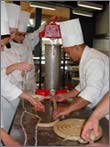
Students at SDCI learn "charcuterie" the art of sausage making. |
Course 161: Garde Manger I (The Cold Kitchen)
This class provides the student with a foundation in Garde Manger
or the cold kitchen. Basic salad preparations, vinaigrettes, emulsified
and non-emulsified dressings, cold sauces, salad condiments, sandwiches,
canapés, and cold hors d'oeuvres are covered in this class.
1 Credit, 32 hours
Level: Introductory
Prerequisite: Kitchen Skills IV
Next: Garde Manger II |
|
Course 162: Garde Manger II
Through demonstration, lecture and hands-on techniques, the student
further refines cold preparation skills and begins an emphasis on
classical and modern hot and cold presentation techniques. Appropriate
garnishes and their preparation are demonstrated by the Chef Instructor
and then practiced by the class.
1 Credit, 32 hours
Level: Introductory
Prerequisite: Garde Manger I
Next: Baking Skills I |
|
 |
|
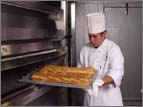
Students in the baking and pastry program learn to make a
variety of breads. |
Course 144: Baking Skills I
This class is an introduction to basic bread making and pastry techniques.
Direct bread making technique is taught, including baguettes, soft
rolls and pizza. The student learns basic pastry dough: tart dough,
pie dough and éclair dough. Students learn to prepare pastry
cream and other pie and tart fillings including fruit and baked custard
fillings. The class studies how to make muffins, quick breads and
scones.
1 Credit, 32 hours
Level: Introductory
Prerequisite: HACCP (Hazard Analysis Critical Control Point)
Previous: Garde Manger II
Next: Baking Skills II |
|
Course 145: Baking Skills II
This class concentrates on custards, mousses, basic cakes and icings
including Genoise (sponge cake), and butter cakes with meringue and
cream-based icings. The student learns cake assembly, plated dessert
presentation, and basic decoration. Basic piping and decorating skills
are covered.
1 Credit, 32 hours
Level: Introductory
Prerequisite: Baking Skills I
Next: Breakfast Cookery |
|
Course 159: Breakfast Cookery
A great beginning - learn the fundamental preparations and techniques
to enter this rapidly expanding segment of the food industry. Egg
cookery techniques include scrambled, pan-fried, poached and baked
methods. Omelet preparations include traditional method, frittatas,
soufflé omelet and other healthy alternative preparation techniques.
Select and prepare breakfast meats and learn the techniques of griddlecakes,
including pancakes and crepes. Selection and techniques for preparing
breakfast cereals and grains conclude the class.
0.5 Credit, 16 hours
Level: Introductory
Prerequisite: Kitchen Skills IV
Previous: Baking Skills II
|
 |
|
|
|
|
|
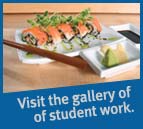
| Students are taught the art of plate presentation at every step of their training. |
|
|
|
 |
|
|
|
|
|
|
|














,scrollbars=0,resizable=1'));)
,scrollbars=0,resizable=1'));)
);)