





The Commis Culinary program represents the culmination of years of research and program development by some of the finest culinary educators in the country. Based upon proven methods of culinary education and incorporating current thinking on how people learn, the Commis Method leads aspiring Chefs through a more logical series of courses. This is an educational strategy that makes more sense. Each course in the series leads naturally to the next and relies inevitably on the preceding.
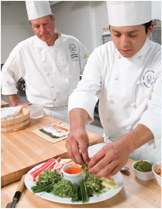
This is a hands-on program (80% of your studies take place in the kitchen). We believe that culinary students learn more working in a kitchen, with product. At SDCI, every student prepares food every day — no fighting for space or kitchen resources with other students. And again, you learn techniques, not recipes. With a command of foundational techniques, Commis students can execute virtually any recipe from any cookbook, rather than a limited number of dishes taught out of a cookbook.

The Commis Method will first lead you through foundational courses: in flavor, business, and professional concerns (such as safety and sanitation and the history of the profession).
Next students move into the kitchen to train in: knife skills; fundamental techniques — poach, braise, roast, sauté, etc.; stocks; sauces — the mother sauces, classic small sauces. Throughout students apply their earlier theoretical work in flavor and reinforce fundamental business concepts. They learn the delicate art of seasoning.
The Commis Method demands that while in the kitchen, students work in small groups, with limited class sizes. Students first observe the Chef demonstrate each new skill and then practice it under his watchful eye. Students practice culinary theory in the kitchen with product; they don't just read about it in a book or hear about it in a crowded lecture hall.
In the next sequence, students learn to apply fundamental techniques to a wider variety of proteins and classic preparations. They practice with a variety of equipment.
Flavor and business: the Commis Method revolves around these two essential pillars and virtually every course day in the program teaches or reinforces both. Appreciate a new concept of flavor, how to engage not just taste but all five senses, and which flavors always work together and those that don't.
After years of experience in the kitchen, the successful fine dining Chef learns to understand the intricacies of flavor, how they interact with the human physiology, how certain flavors always seem to work together as 'flavor friends' and others seem to fight with one another as 'flavor enemies'. SDCI's new concept of flavor teaches you to engage touch, hearing, smell, sight, taste — and also a 6th sense. Once you study the Commis Method, each of these senses will play a role in your cooking.
In addition, learn to incorporate business fundamentals in everything you do in the kitchen: profit and loss, marketing, kitchen design. SDCI is a professional culinary school — not just a place to learn to cook. Most of our students aspire to become Chefs. Today's successful Chef must be more than just a good cook, but must also understand how to run a business. > Learn more about Career Planning
Gainful Employment Disclosure - Commis de Cuisine Program
Program Name: Commis(TM) de Cuisine
Program Length (clock hours/weeks) 872 hours/30 weeks
CIP Codes 12.0503
SOC Code/s 35-1011, 35-2013, 35-2000, 35-2012, 35-2019, 35-2014
SOC Occupations Chefs, Executive, Certified Personal, Private Chefs, Sous chefs, personal chefs, head cooks, cooks, banquet cooks, restaurant cooks, food preparation workers, cooks, all other
Tuition and Fees* $21548 tuition,$230 registration/application fees/State Tuition Recovery Fund
Books & Supplies* $1630 (This fee is for the student kit that includes the cost of books, uniforms, and knife kit)
*For completion within published program length.
Median Loan Debt, Title IV: $7773
Median Loan Debt, Private Loans: $10439
Median Loan Debt, Institutional Financing: $1626.50
On-Time Completion Rate: 84.4%
Placement Rates 82% for State ACCET - Accrediting agency rates
Placement Rate Source/Methodology Description: Placement Rate
The placement rate, calculated by dividing the number of graduates
(completers) employed in the field by the number of graduates available for employment.
“Graduates available for employment” means the number of graduates minus the number of graduates unavailable for employment.
“Graduates employed in the field” means graduates who are gainfully employed within six months of graduation in a position for which the skills obtained through the education and training provided by the institution are required or provided a significant advantage to the graduate in obtaining the position.
“Graduates unavailable for employment” means graduates who, after graduation, die, become incarcerated, are called to active military duty, are international students that leave the United States or do not have a visa allowing employment in the United States, or are continuing their education at an accredited or bureau-approved postsecondary institution.
Come to see our program for yourself. Contact us today and discover how you could begin a new career in the culinary arts.
Call us at 619.644.2100
Click HERE to download Gainful Employment disclosures on this program.